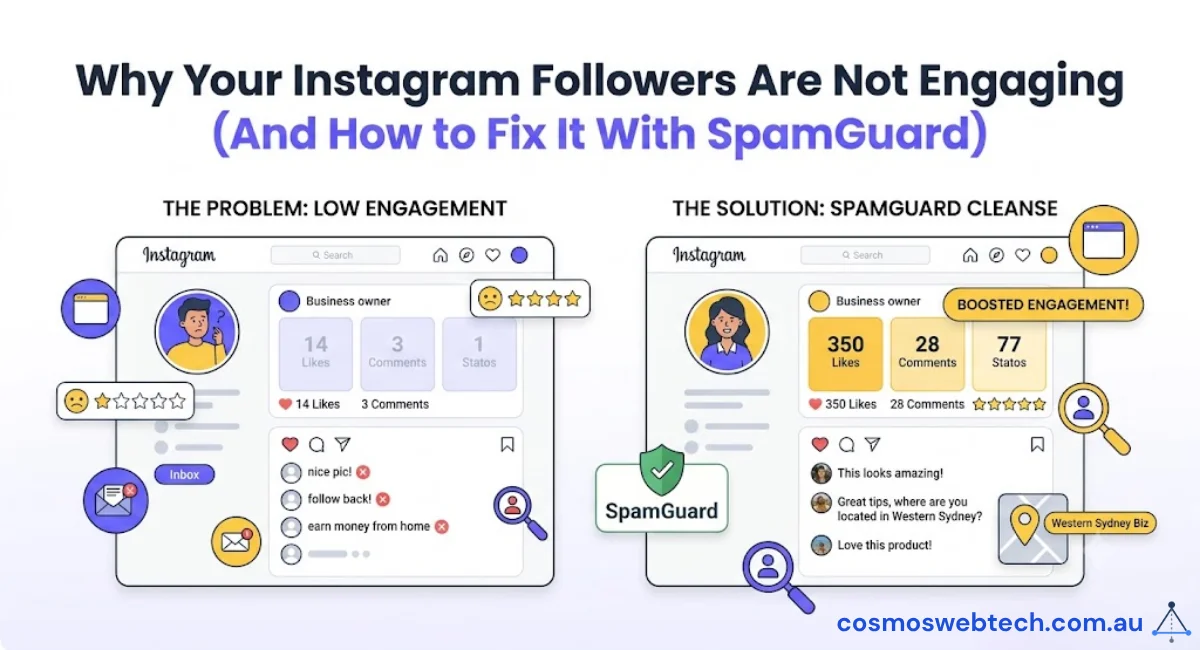
Affiliate disclosure. Some links in this post are affiliate links, including our link to SpamGuard. If you sign up through them we may earn a small commission at no extra cost to you. We only recommend tools we would use ourselves or set up for paying clients — every recommendation here reflects what we genuinely think helps a Western Sydney business.
You Have 1,800 Followers. So Why Is Nobody Liking Your Posts?
Picture this. You have been posting on Instagram for 18 months. You have built up 1,800 followers — not bad for a local Parramatta or Blacktown business working hard on social media without a big marketing budget. You post a photo of your latest work, a special offer, or a behind-the-scenes look at your team. You wait. By the next morning, eight people have liked it.
Eight likes from 1,800 followers.
You start to wonder if you are doing something wrong. Is the content boring? Are you posting at the wrong time? Should you be using more hashtags? Should you be posting Reels instead of photos?
Before you spend another weekend second-guessing your content strategy, here is the honest truth: the problem probably is not your content at all. The problem is who is actually in your follower list.
For many Western Sydney small businesses, a large chunk of their Instagram followers are not real, active customers. They are bots, inactive accounts, and ghost profiles that never open the app. And those followers are quietly killing your account’s reach every single day.
Why Your Engagement Rate Matters More Than Your Follower Count
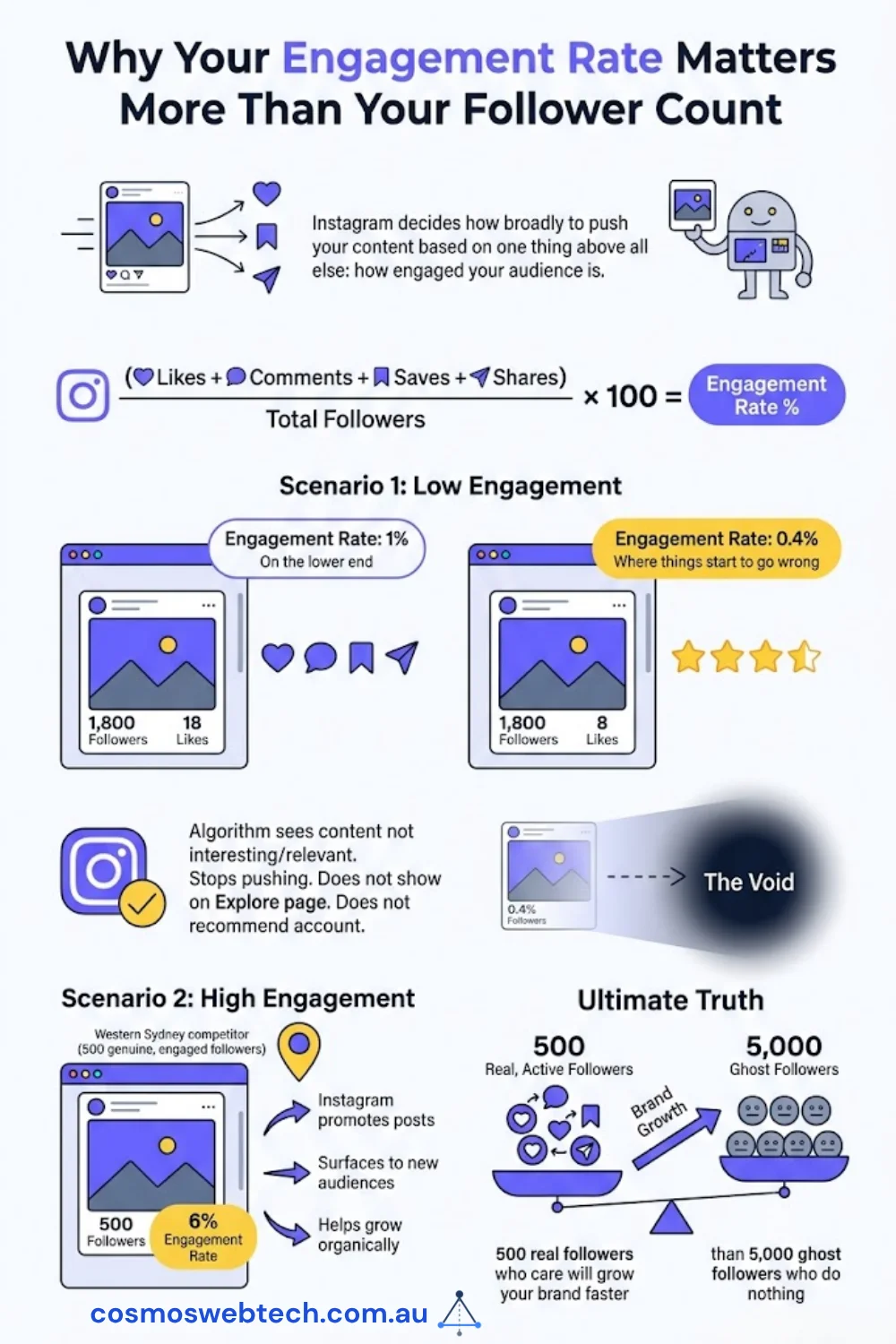
Instagram does not show your posts to everyone who follows you. It decides how broadly to push your content based on one thing above all else: how engaged your audience is.
Engagement rate is a simple calculation. You take the number of interactions a post gets — likes, comments, saves, shares — and divide it by your total followers, then multiply by 100 to get a percentage.
So if you have 1,800 followers and a post gets 18 likes, your engagement rate is 1%. That is on the lower end. If you have 1,800 followers and only get 8 likes, your engagement rate drops to 0.4% — and that is where things start to go wrong.
Instagram’s system sees that only 0.4% of your followers responded to your post. It interprets this as a signal that the content is not interesting or relevant. So it stops pushing it. It does not show the post to non-followers through the Explore page. It does not recommend your account to new people. Your content quietly disappears into the void.
Meanwhile, a local competitor with 500 genuine, engaged followers who all live in Western Sydney and interact with every post has a 6% engagement rate. Instagram loves that account. It promotes their posts, surfaces them to new audiences, and helps them grow organically.
The hard truth is this: 500 real followers who care about your business will grow your brand faster than 5,000 ghost followers who do nothing at all.
The Four Types of Fake and Low-Quality Followers
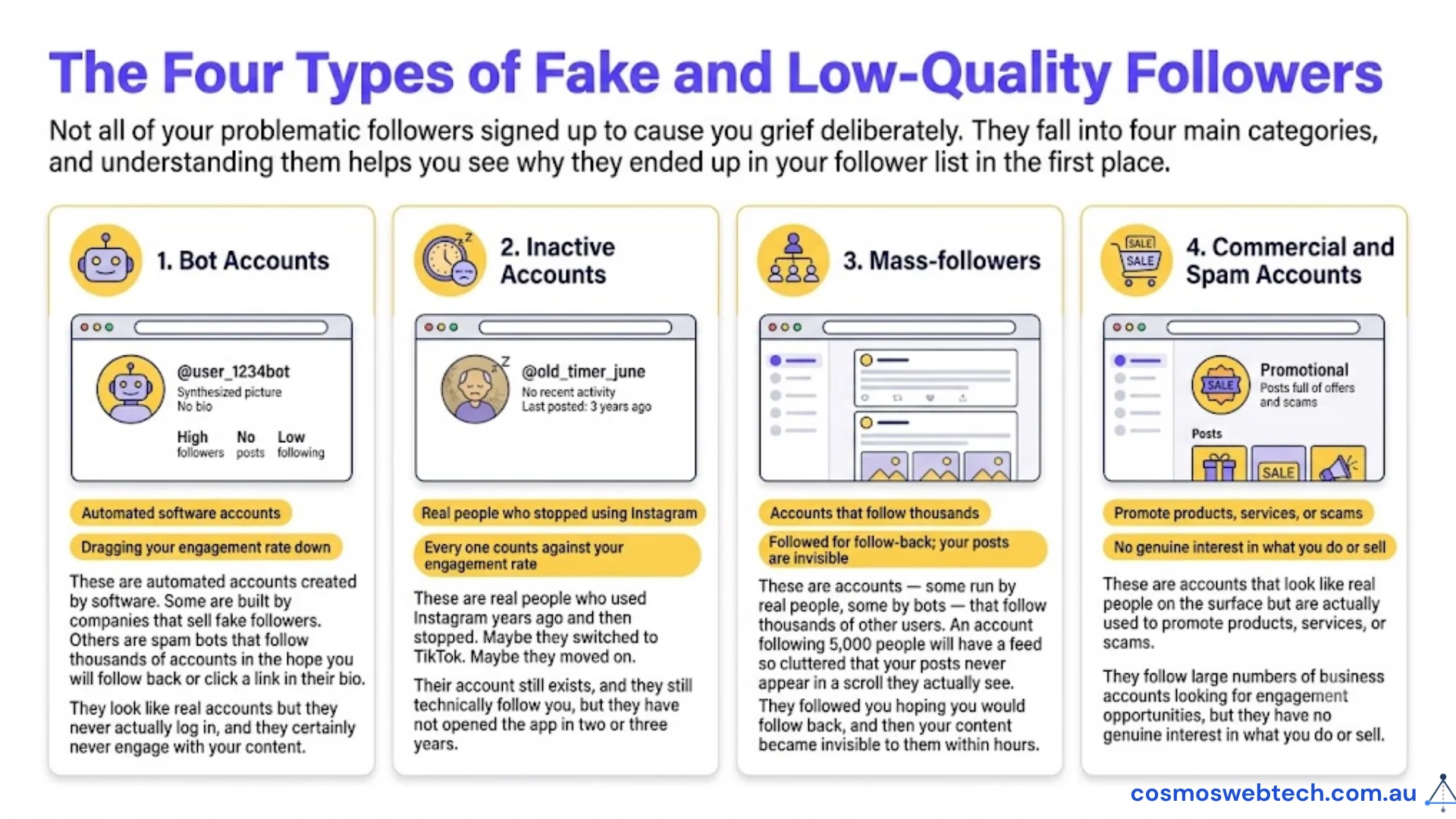
Not all of your problematic followers signed up to cause you grief deliberately. They fall into four main categories, and understanding them helps you see why they ended up in your follower list in the first place.
1. Bot accounts
These are automated accounts created by software. Some are built by companies that sell fake followers. Others are spam bots that follow thousands of accounts in the hope you will follow back or click a link in their bio. They look like real accounts but they never actually log in, and they certainly never engage with your content. They just sit in your follower list dragging your engagement rate down.
2. Inactive accounts
These are real people who used Instagram years ago and then stopped. Maybe they switched to TikTok. Maybe they moved on. Their account still exists, and they still technically follow you, but they have not opened the app in two or three years. Every one of these former users counts against your engagement rate.
3. Mass-followers
These are accounts — some run by real people, some by bots — that follow thousands of other users. An account following 5,000 people will have a feed so cluttered that your posts never appear in a scroll they actually see. They followed you hoping you would follow back, and then your content became invisible to them within hours.
4. Commercial and spam accounts
These are accounts that look like real people on the surface but are actually used to promote products, services, or scams. They follow large numbers of business accounts looking for engagement opportunities, but they have no genuine interest in what you do or sell.
How Did These Followers End Up On Your Account?
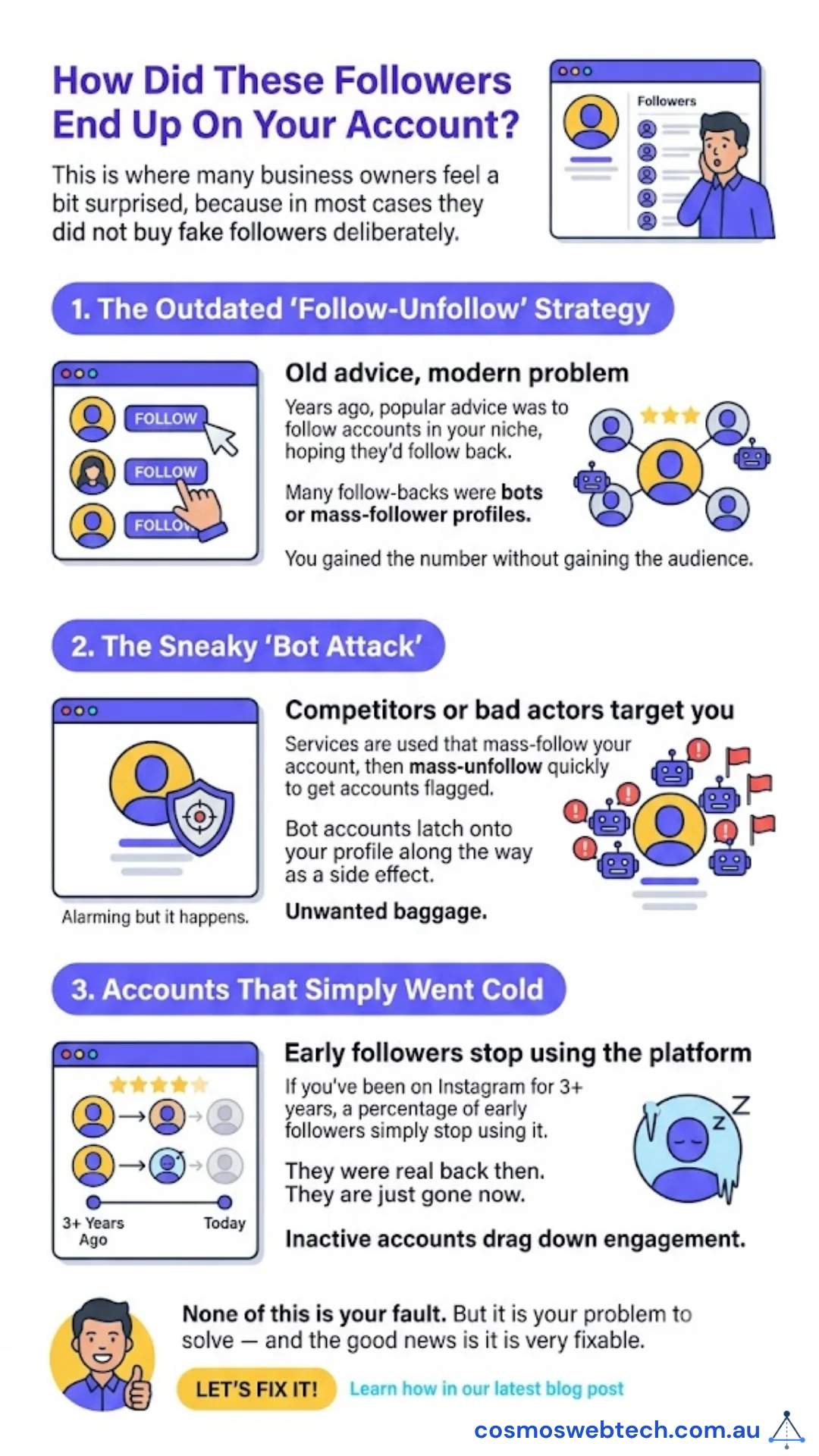
This is where many business owners feel a bit surprised, because in most cases they did not buy fake followers deliberately.
The most common path is the old follow-unfollow method. A few years ago, it was popular advice to follow other accounts in your niche in the hope they would follow you back. The problem is that many of the accounts following back were bots or mass-follower profiles. You gained the number without gaining the audience.
Another route is a bot attack. This sounds alarming, but it does happen. Some competitors or bad actors use services that mass-follow a target account and then mass-unfollow them in quick succession, which can get accounts flagged. Along the way, bot accounts latch onto your profile as a side effect.
Then there are simply the accounts that went cold. If you have been on Instagram for three or more years, a percentage of your early followers have simply stopped using the platform. They were real back then. They are just gone now.
None of this is your fault. But it is your problem to solve — and the good news is it is very fixable.
How SpamGuard Works: A Step-by-Step Walkthrough
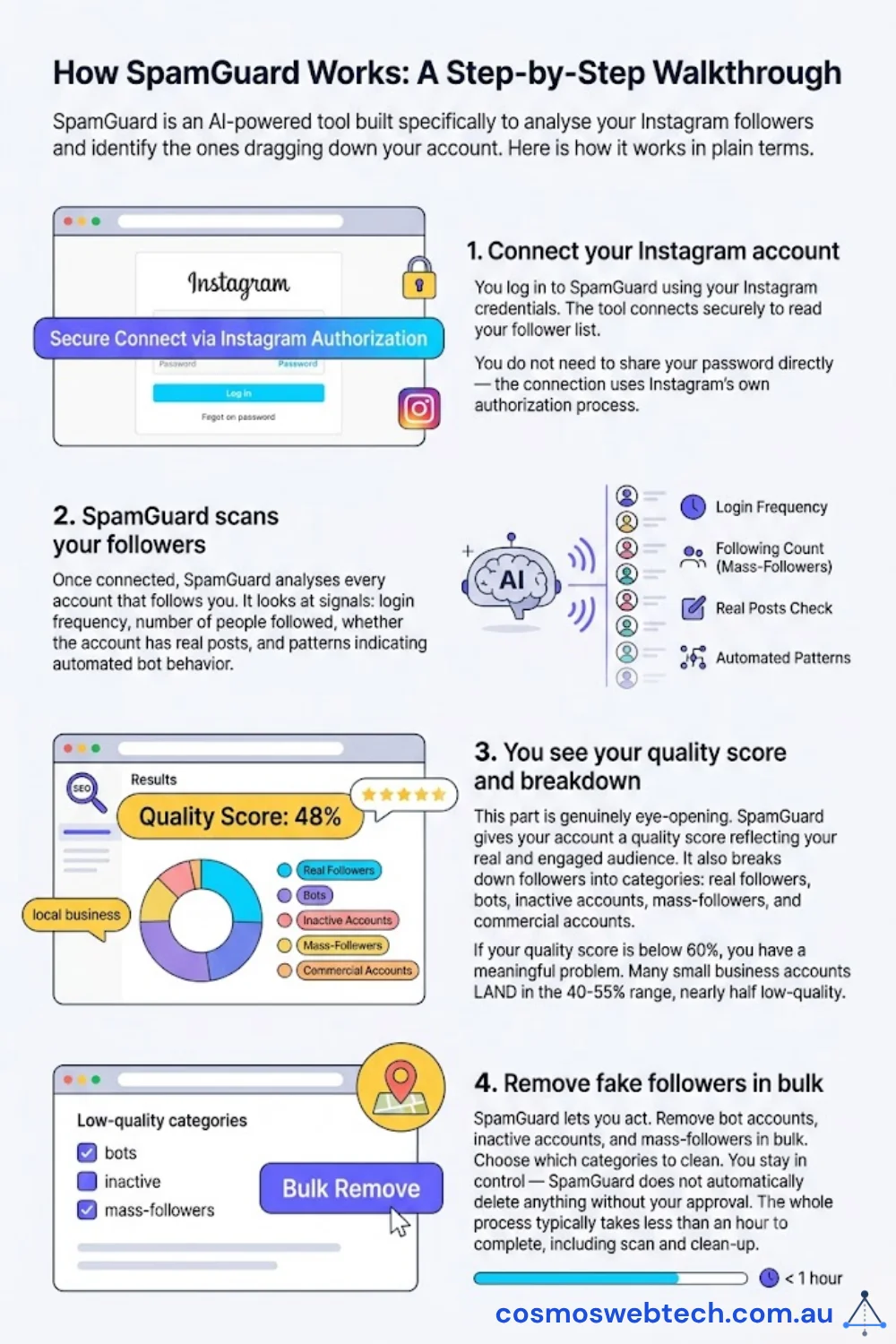
SpamGuard is an AI-powered tool built specifically to analyse your Instagram followers and identify the ones dragging down your account. Here is how it works in plain terms.
Step 1: Connect your Instagram account
You log in to SpamGuard using your Instagram credentials. The tool connects to your account securely to read your follower list. You do not need to share your password directly with anyone — the connection uses Instagram’s own authorisation process.
Step 2: SpamGuard scans your followers
Once connected, SpamGuard analyses every account that follows you. It looks at a range of signals: how often the account logs in, how many people it follows (accounts following thousands of people are flagged as mass-followers), whether the account has any real posts, and patterns that indicate automated bot behaviour.
Step 3: You see your quality score and breakdown
This is the part most business owners find genuinely eye-opening. SpamGuard gives your account a quality score — a percentage that reflects how much of your audience is real and engaged. It also breaks down your followers into categories: real followers, bots, inactive accounts, mass-followers, and commercial accounts.
If your quality score is below 60%, you have a meaningful problem. Many small business accounts that have been active for a few years land in the 40-55% range, which means nearly half their follower list is low-quality.
Step 4: Remove fake followers in bulk
SpamGuard lets you act on what you find. You can remove bot accounts, inactive accounts, and mass-followers in bulk. You choose which categories to clean and let the tool work through the list. You stay in control the entire time — SpamGuard does not automatically delete anything without your approval.
The whole process typically takes less than an hour to complete, including the scan and the clean-up.
What to Expect After You Clean Your Follower List
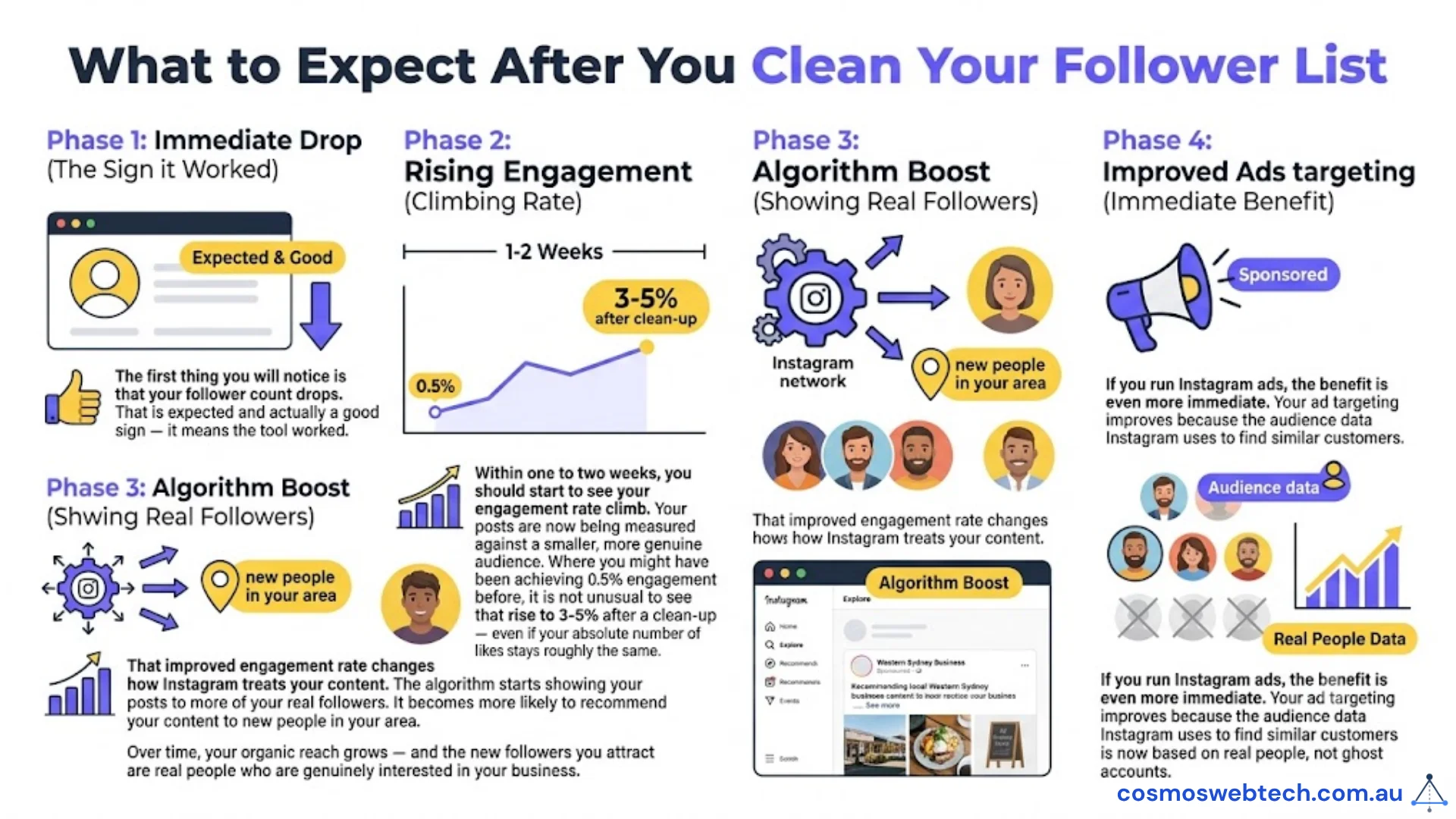
The first thing you will notice is that your follower count drops. That is expected and actually a good sign — it means the tool worked.
Within one to two weeks, you should start to see your engagement rate climb. Your posts are now being measured against a smaller, more genuine audience. Where you might have been achieving 0.5% engagement before, it is not unusual to see that rise to 3-5% after a clean-up — even if your absolute number of likes stays roughly the same.
That improved engagement rate changes how Instagram treats your content. The algorithm starts showing your posts to more of your real followers. It becomes more likely to recommend your content to new people in your area. Over time, your organic reach grows — and the new followers you attract are real people who are genuinely interested in your business.
If you run Instagram ads, the benefit is even more immediate. Your ad targeting improves because the audience data Instagram uses to find similar customers is now based on real people, not ghost accounts.
Is It Safe to Remove Followers?
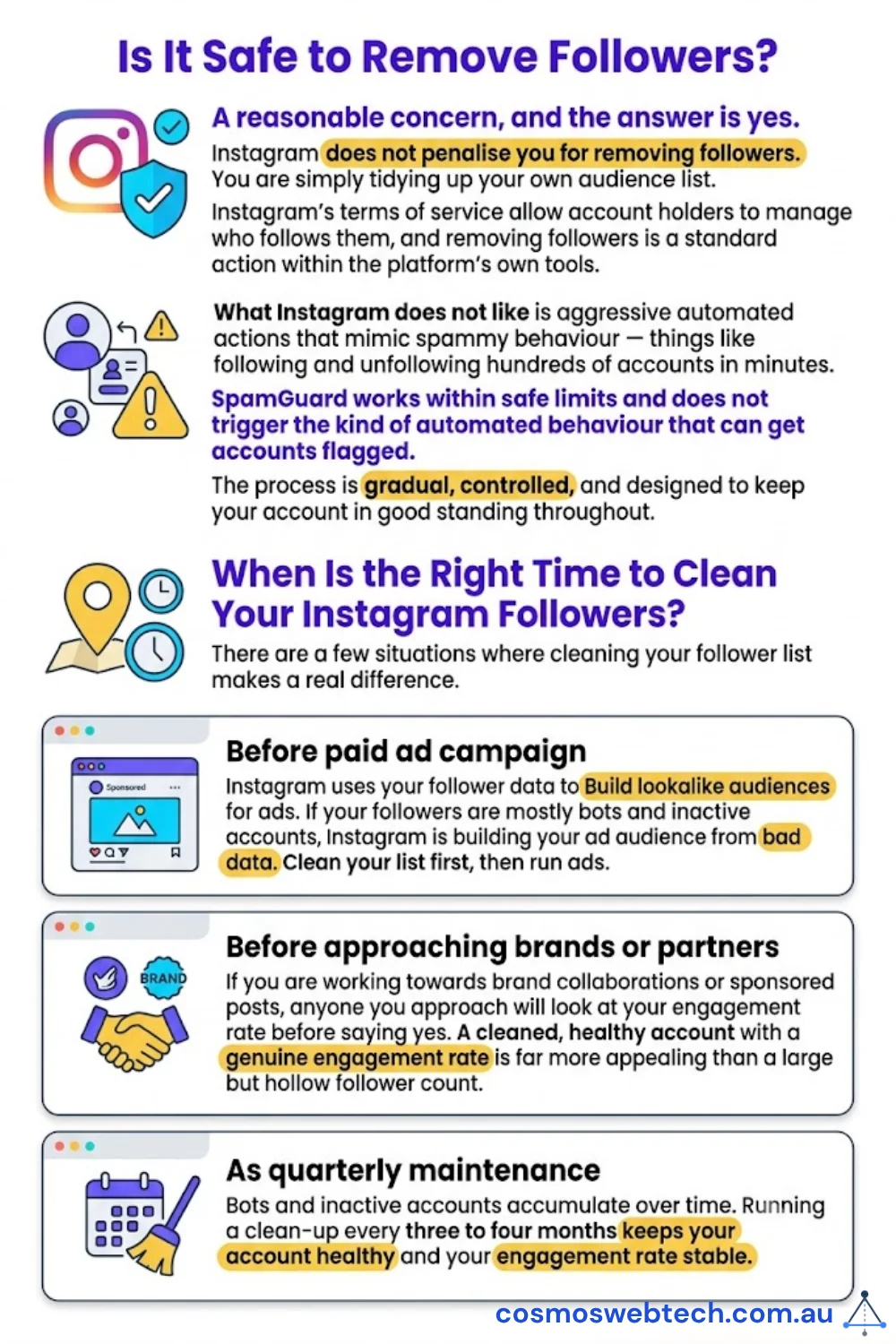
This is a very reasonable concern, and the answer is yes. Instagram does not penalise you for removing followers. You are simply tidying up your own audience list. Instagram’s terms of service allow account holders to manage who follows them, and removing followers is a standard action within the platform’s own tools.
What Instagram does not like is aggressive automated actions that mimic spammy behaviour — things like following and unfollowing hundreds of accounts in minutes. SpamGuard works within safe limits and does not trigger the kind of automated behaviour that can get accounts flagged.
The process is gradual, controlled, and designed to keep your account in good standing throughout.
When Is the Right Time to Clean Your Instagram Followers?
There are a few situations where cleaning your follower list makes a real difference.
Before running a paid ad campaign. Instagram uses your follower data to build lookalike audiences for ads. If your followers are mostly bots and inactive accounts, Instagram is building your ad audience from bad data. Clean your list first, then run ads.
Before approaching brands or partners. If you are working towards brand collaborations or sponsored posts, anyone you approach will look at your engagement rate before saying yes. A cleaned, healthy account with a genuine engagement rate is far more appealing than a large but hollow follower count.
As quarterly maintenance. Bots and inactive accounts accumulate over time. Running a clean-up every three to four months keeps your account healthy and your engagement rate stable.
For a complete review of your business’s digital presence — including your website, local SEO, and Google Business Profile — Cosmos Web Tech offers free website and digital marketing audits for Western Sydney small businesses.
Cloud Geeks provides managed IT support and cybersecurity for Sydney SMBs, including protection against account takeover and social media security best practices.
Part of the Ganda Tech Services family, Cosmos Web Tech delivers web design and digital marketing for Western Sydney small businesses.
Frequently Asked Questions
Is SpamGuard safe to use with my Instagram account?
Yes. SpamGuard connects to your Instagram account using a standard authorisation process and works within Instagram’s guidelines. It does not require you to hand over your password in an unsafe way, and it does not perform the kind of mass automated activity that can get accounts flagged. Many businesses across Australia use it for routine account maintenance.
How many fake followers do most small business accounts have?
It varies quite a bit depending on how long the account has been active and what growth tactics were used in the past. From what SpamGuard reports across accounts it has analysed, it is common for a small business account that has been active for three or more years to have between 30% and 50% of followers classified as bots, inactive accounts, or mass-followers. That is a significant drag on your engagement rate and reach.
Will I lose my follower count significantly?
You will see your number drop after a clean-up, and how much depends on what SpamGuard finds. Accounts that used follow-unfollow tactics in the past, or that have been active for many years, sometimes see their count reduce by 20-40%. That can feel confronting at first. But the followers you lose were never going to like, comment, buy from you, or recommend you — so the number was always misleading. Your real audience stays intact.
How often should I clean my Instagram followers?
A quarterly review is a sensible routine for active business accounts. Bot accounts and inactive followers accumulate naturally over time, so a clean-up every three to four months keeps your engagement rate healthy. If you are planning a significant push — a product launch, a local event, or an ad campaign — it is worth running a clean-up beforehand so you are starting from a solid base.
Does removing fake followers help with Instagram ads?
Yes, in two meaningful ways. First, Instagram uses your follower data to build lookalike audiences when you run ads — so cleaner followers means better targeting for your paid campaigns. Second, your organic content will reach more real people in the lead-up to running ads, which warms up your audience before you spend money. Many Western Sydney business owners find their cost per result drops noticeably after cleaning their follower list and then launching a paid campaign.