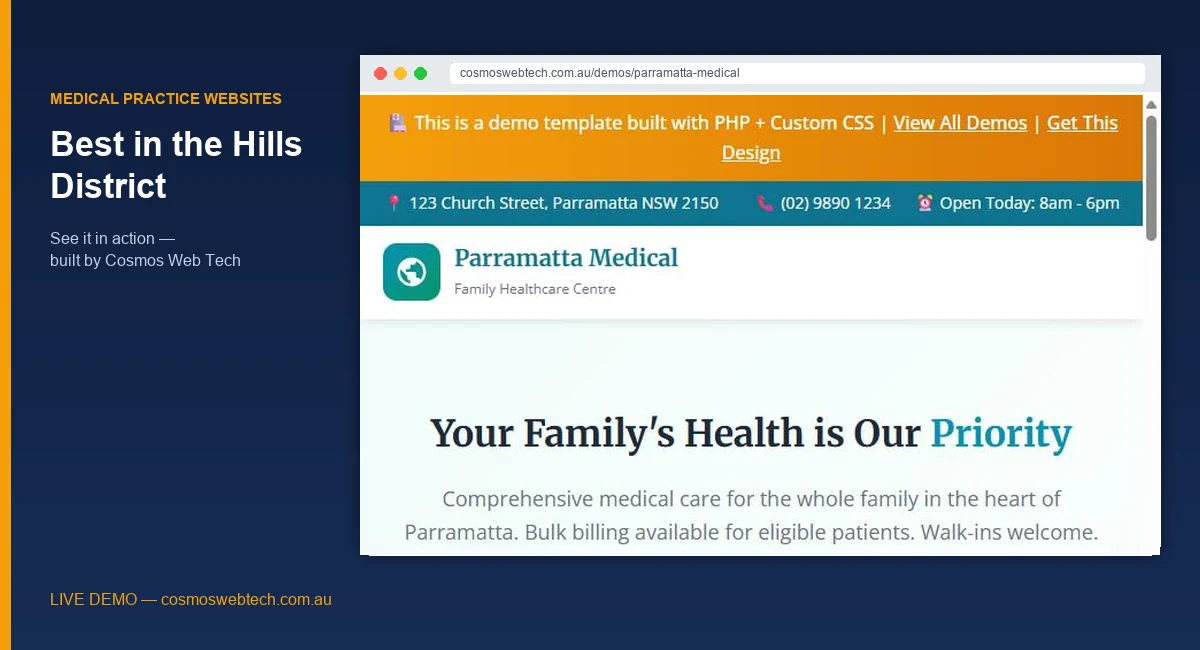
If you run a medical practice in Castle Hill, Bella Vista, Baulkham Hills, or anywhere across the Hills District, your website is your front door — and most patients will knock on it before they ever step into your waiting room. Medical practice websites in Hills District now compete on design, speed, and local trust signals just as much as they compete on clinical reputation.
The question is: what does a great medical website actually look like? Rather than recycle generic advice, we spent time reviewing high-performing medical practice websites across the Hills District to understand what the best ones do differently. Here is what we found.
Why Hills District Medical Practice Websites Matter More Than You Think
Before diving into the case studies, consider this: Google research shows that 77% of patients use search engines before booking a healthcare appointment. In a suburb like Castle Hill — where there are dozens of competing GPs, specialist clinics, and allied health providers — the practices that convert visitors into patients share a handful of clear design principles.
These are not fancy tricks. They are deliberate, practical choices that any local practice can adopt.
What High-Performing Hills District Medical Websites Have in Common
1. Online Booking That Works on Mobile
The standout feature across every high-performing medical practice website in Hills District we reviewed was a seamless online booking system — and crucially, one that worked perfectly on a smartphone.
Consider a busy GP clinic in Baulkham Hills that integrated HotDoc directly into their homepage. Patients can see real-time appointment availability and book within three taps, without being redirected to a confusing external portal. The clinic reported a 35% reduction in phone enquiries within two months of launching the upgraded site — freeing up reception staff while improving patient satisfaction.
This matters for Hills District practices specifically. Castle Hill, Kellyville, and Norwest are home to time-poor professionals and families. They will not call between 9 and 5 to book an appointment. They will book at 9pm on their phone — or they will book with the competitor who lets them.
What to do: Embed your booking system (HotDoc, HealthEngine, or similar) directly into your homepage and every service page. Test it monthly on an iPhone and an Android device.
2. A Clear, Confidence-Building Homepage Structure
One of the most common mistakes we see with Hills District medical websites is a cluttered homepage that tries to communicate everything at once. The best performing sites keep it simple with a structure that follows patient psychology:
- Who you are — Practice name, location, and specialty, above the fold
- Who you serve — “Bulk billing GP for families in Castle Hill and surrounds”
- What to do next — A prominent “Book Online” or “Call Us” button
- Proof of trust — Google review rating, years in practice, or accreditation logos
A well-designed Allied Health clinic in Bella Vista exemplified this perfectly. Their homepage opened with a clean hero section: practice name, suburb, and a single green “Book an Appointment” button. Below that, patient Google reviews were displayed automatically via a widget. No sliders. No stock photos of stethoscopes. Just what a nervous new patient needs to feel confident.
What to do: Audit your homepage using this four-point checklist. If a new visitor cannot answer all four questions within ten seconds of landing, it is time for a redesign.
3. Local SEO Built Into Medical Practice Website Content
The best medical practice websites in the Hills District do not just exist — they are found. And being found means weaving local context into your website content strategically.
A physiotherapy practice in Norwest Marketown had invested in a blog that answered hyper-local questions: “What to do after a sports injury in Hills District”, “How to find a bulk-billing physio near Castle Hill”. These posts consistently ranked on page one of Google for “physio Castle Hill” and related terms, driving organic traffic without ongoing ad spend.
This is not accidental. It is the result of treating website content as a long-term asset, not a set-and-forget brochure.
Key local SEO moves we observed across top performers:
- Suburb name in the page title and H1 (e.g., “General Practice Castle Hill”)
- Google Business Profile linked and verified, with matching NAP (name, address, phone)
- Separate service pages for each specialty (not everything crammed onto one page)
- Schema markup indicating the practice as a
MedicalBusinesswith operating hours
What to do: Create a dedicated page for each service you offer, and include the suburb in the page title and first paragraph. Start with your two or three most-searched services.
4. Clear Accessibility and NDIS/DVA Information
Many Hills District medical and allied health practices serve patients with specific needs — NDIS participants, DVA card holders, bulk-billing concession card holders. The practices that convert these patients online make this information impossible to miss.
A specialist clinic in Winston Hills added a simple “Patient Information” section to their navigation with dedicated pages for NDIS, DVA, and Medicare billing. Each page used plain language to explain exactly what patients were entitled to and how to bring their documentation. The result was a meaningful increase in enquiries from NDIS-funded patients who previously struggled to work out whether the clinic accepted them.
This kind of clarity builds trust — and trust is the deciding factor when a patient is choosing between two clinics with similar services.
What to do: Add a “Patient Information” or “Fee Guide” section to your website. Use plain language. Assume your reader is anxious and time-poor.
5. Fast Load Times and No Clutter
Speed kills — or rather, slowness kills conversions. Google’s Core Web Vitals research consistently shows that pages taking longer than three seconds to load lose more than half their visitors.
Medical websites are particularly guilty of loading slowly due to large image files, autoplay videos, and bloated WordPress themes. The top-performing sites we reviewed scored between 85 and 95 on Google PageSpeed Insights for mobile — achieved through compressed images, minimal plugins, and clean hosting.
A dental practice in Castle Hill revamped their website with a lightweight WordPress theme and image compression. Load time dropped from 5.8 seconds to 1.9 seconds. Organic enquiry rate improved noticeably in the months following.
What to do: Test your site at PageSpeed Insights. If your mobile score is below 70, it is time to act. Common fixes include compressing images, removing unused plugins, and upgrading your hosting.
The Pattern That Ties All Hills District Medical Websites Together
Looking across these examples, the theme is consistency. The best medical practice websites in the Hills District are not flashy — they are dependable. They load fast, explain clearly who they help, make booking easy, and communicate trust.
These are not luxury improvements. In a competitive local market, they are the baseline that patients now expect.
What Does a Redesign Actually Cost?
For a Hills District medical or allied health practice, a professional website redesign typically costs between $3,500 and $6,500, depending on the number of service pages, integration complexity (HotDoc, HealthEngine, practice management software), and whether you need a new logo or photography.
That investment routinely pays for itself within three to six months when it converts even one or two additional patients per week who would otherwise have bounced to a competitor.
Frequently Asked Questions About Medical Practice Websites in Hills District
How much does a medical practice website cost in Hills District?
A professional medical practice website in the Hills District typically costs between $3,500 and $6,500. This covers design, development, online booking integration (HotDoc or HealthEngine), and local SEO setup. Most practices recoup this investment within three to six months through improved patient conversions.
What features should a GP website have to rank on Google in Castle Hill?
A GP website in Castle Hill should include the suburb name in the page title and H1 heading, a verified Google Business Profile with matching NAP (name, address, phone), separate service pages for each specialty, MedicalBusiness schema markup with operating hours, and an embedded online booking system. A regularly updated blog with hyper-local content significantly improves organic rankings over time.
What is the best online booking system for Hills District medical practices?
HotDoc and HealthEngine are the two most widely used booking systems for Hills District practices. HotDoc integrates directly with most Australian practice management systems (Best Practice, Zedmed, Medical Director) and allows real-time availability on your homepage. Both should be embedded directly on your site rather than requiring patients to navigate to an external portal.
How long does it take to build a medical practice website in Hills District?
A professionally designed medical practice website in Hills District typically takes four to six weeks to build from brief to launch. This includes discovery, design mockups, content entry, booking system integration, local SEO setup, and mobile testing. Practices with photography and written content ready to supply can often shorten this timeline.
Ready to Upgrade Your Practice Website?
At Cosmos Web Tech, we specialise in web design for Hills District healthcare and allied health businesses. We know the local market, we understand what Hills District patients are searching for, and we build websites that work as hard as you do.
Book a free 30-minute website review — we will walk you through exactly what is working, what is not, and what the highest-impact improvements would be for your practice.
Contact us today or call us directly to get started.
Cosmos Web Tech is a Hills District-based web design agency helping local businesses grow online. We work with medical practices, allied health providers, and professional services across Castle Hill, Bella Vista, Norwest, Baulkham Hills, and Western Sydney.
Last updated: March 2026
For practices needing patient-data hosting that meets the Privacy Act 1988 and APP requirements — Cloud Geeks provides Australian-onshore cloud and managed IT for Hills District medical and allied health practices.
Ash Ganda covers how Australian healthcare practices are using AI for admin automation, intake processing, and clinical documentation without compromising patient privacy.
If your practice is planning a patient-facing booking or check-in app — Awesome Apps builds iOS and Android apps for Australian medical and allied health practices.
Part of the Ganda Tech Services family, Cosmos Web Tech delivers specialist web design and digital marketing for Australian small and medium businesses.